
Reference: VE-WA-001
Compliance Is an Organisation-Wide Responsibility
Water hygiene management is often viewed primarily as an estates or facilities responsibility — something that sits with a single named individual or contractor and operates more or less independently of the rest of the organisation. In reality, the decisions that drive water hygiene risk are made every day by people across the business who would not consider themselves to be involved in Legionella compliance at all.
Occupancy patterns, operational processes, procurement decisions, day-to-day building usage and even cleaning regimes can all directly influence water hygiene risks. A decision to mothball one floor of an office building, to change which kitchen is used for staff coffee, or to bring in a new contractor for a refit, all change the water system's behaviour — even if none of those decisions was framed as a water hygiene decision.
Where responsibility is concentrated in one person or team, the wider organisation has no real visibility of how its actions affect risk. The first time the issue is noticed is often when a routine inspection or audit raises it.
Communication Failures Increase Risk
Unused office areas, changing clinical usage, temporary building closures, or reduced occupancy levels may not always be communicated promptly to the team responsible for water hygiene. The result is that monitoring continues against assumptions that are no longer true: outlets thought to be in daily use are actually stagnant, while areas thought to be empty have been quietly reopened.
Similarly, refurbishment works commissioned by external contractors may introduce deadlegs or alter system layouts without estates teams receiving sufficient technical information. The contractor finishes the job, the snagging list closes, and the technical change is buried in a project handover pack that nobody reads.
Large-scale building closures over recent years highlighted this challenge on a national scale. Buildings emptied overnight, occupancy expectations changed, and water hygiene teams in many sectors had to scramble to issue mass flushing or chlorination programmes because the routine assumption that the building was being used as designed had abruptly stopped being true.
The Role of Leadership and Training
Senior management involvement is equally important. Legionella compliance is ultimately a governance issue requiring clear accountability, named responsibilities, and ongoing organisational support. Where it sits low in the organisational chart, it competes for attention with everything else on the estates manager's plate.
Training and awareness across wider departments can significantly improve compliance resilience. Front-line staff do not need to become water hygiene specialists — but they do need to know who to contact when something changes, when something looks unusual, and when planned work will affect water systems. A short induction module, an annual refresher, and clear escalation routes go a long way.
Leadership also matters because compliance often requires capital expenditure: replacing a calorifier, removing redundant pipework, upgrading a TMV regime, or installing remote temperature monitoring. These are decisions made above the level of the responsible person, and need to be supported as an investment in risk reduction rather than a discretionary line item.
Building a Collaborative Approach
Successful Legionella control is rarely achieved through isolated technical activity alone. It depends on a working relationship between estates, clinical or operational teams, procurement, contractors and senior leadership — each of whom has a role in either creating or reducing risk.
The practical version of this is straightforward: water hygiene representation in change-management meetings, a clear protocol for notifying changes in occupancy or use, contractual requirements on refurbishment contractors to co-ordinate with the responsible person, and a regular reporting line into senior management. None of these requires specialist expertise — but each requires deliberate organisational design.
The most effective water hygiene arrangements are those where technical controls, operational teams and organisational decision-making remain aligned. Vectair Environmental supports organisations across healthcare, education, commercial and public sector environments to achieve that in practice.
Reference: VE-WA-002
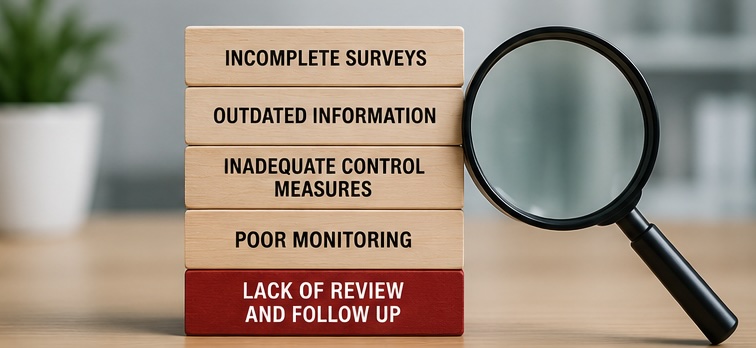
Legionella risk assessments are a legal requirement for any duty holder responsible for a building's water systems — from NHS trusts and schools to leisure centres and commercial premises. Yet in our experience as a specialist water hygiene and Legionella risk management company, the same handful of weaknesses appear in assessment after assessment, often putting both occupants and compliance at risk.
This article looks at five of the most common failures we see when reviewing existing Legionella risk assessments, and what your organisation can do to put them right before they become a regulatory — or, worse, a clinical — problem.
1. Out-of-date assessments that no longer reflect the building
ACoP L8 and HSG 274 are clear: a Legionella risk assessment should be reviewed regularly, and always whenever there is reason to believe the original is no longer valid. A change of use, a refurbishment, a new tenant, or even the installation of a single new outlet can be enough to invalidate an existing assessment.
We routinely encounter risk assessments that are five, six or seven years old, referring to plant rooms and pipework that no longer exist. If your building has changed since the assessment was carried out — and most have — the document on your shelf may no longer offer the protection you think it does.
2. Missing or inaccurate schematic diagrams
Accurate schematics can significantly improve understanding of complex systems and support effective monitoring and remedial planning. Schematic diagrams underpin everything that follows: temperature monitoring routes, flushing regimes, sentinel outlet identification and remedial works.
Where schematics are missing, illegible, or based on the original architect's drawings rather than what was actually installed, the resulting control scheme will inevitably contain blind spots. Our risk assessment service includes schematic diagrams as standard, drawn from on-site verification rather than assumption.
3. Inadequate identification of sentinel and infrequently used outlets
Sentinel outlets form an important part of routine temperature monitoring programmes. Identifying them correctly requires both a sound understanding of the system layout and a careful walk-through of the building.
Equally important is the identification of infrequently used outlets: showerheads in seldom-occupied bedrooms, taps in unused offices, emergency eye-wash stations and decommissioned plant. These are often locations where conditions favourable to Legionella growth can develop, and they are also the points most often missed in a desktop review.
4. Generic recommendations that don't reflect actual risk
A good Legionella risk assessment is not a tick-box exercise. It should set out the specific risks present in your building, the populations potentially exposed to them — staff, patients, students, members of the public — and a prioritised set of remedial and control actions.
Too often we see assessments that simply list HSG 274 verbatim and leave the duty holder to work out what applies. Responsible persons need clear, ranked recommendations, with timescales and ownership, so that compliance can be planned and budgeted rather than reacted to.
5. No clear link between the assessment and the written scheme of control
Under ACoP L8, the risk assessment is the foundation document, but compliance is delivered through the written scheme of control. The two should be tightly linked: every risk identified should map to a defined control measure, and every control measure should map back to the assessment that justified it.
In practice we frequently find the assessment and the scheme have drifted apart — sometimes because they were produced by different contractors, sometimes simply because no-one has reviewed them together for several years. The result is monitoring activity that bears little relation to the actual risks present.
Putting things right
If any of the above sounds familiar, you are far from alone. The good news is that none of these failures is difficult to address when caught early. A combined review of your existing risk assessment, written scheme and recent monitoring records will quickly reveal where the gaps are, and a properly scoped reassessment will close them.
Vectair Environmental has provided Legionella risk assessments to NHS Foundation Trusts, local authorities, private healthcare, education providers and blue-chip industries since 1993. Our assessors hold recognised Legionella and water hygiene qualifications, supported by practical experience across healthcare, education, commercial and public sector environments. Our reports include schematic diagrams, asset registers and prioritised technical recommendations as standard.
If you would like an independent view of your current Legionella arrangements, or to discuss a reassessment of your portfolio, please get in touch with our team on 0118 981 7437 or at


