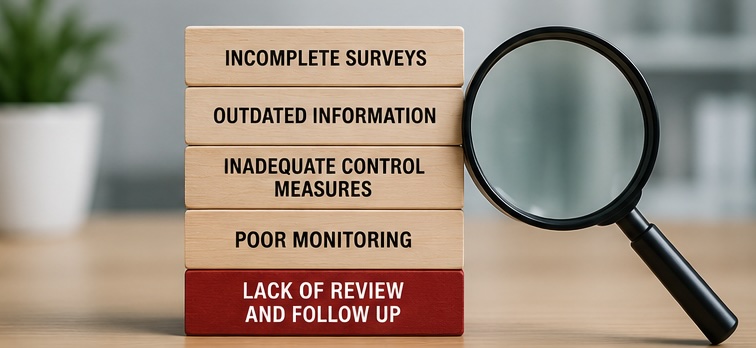
Five Common Failures in Legionella Risk Assessments — and How to Address Them
Reference: VE-WA-002
Legionella risk assessments are a legal requirement for any duty holder responsible for a building's water systems — from NHS trusts and schools to leisure centres and commercial premises. Yet in our experience as a specialist water hygiene and Legionella risk management company, the same handful of weaknesses appear in assessment after assessment, often putting both occupants and compliance at risk.
This article looks at five of the most common failures we see when reviewing existing Legionella risk assessments, and what your organisation can do to put them right before they become a regulatory — or, worse, a clinical — problem.
1. Out-of-date assessments that no longer reflect the building
ACoP L8 and HSG 274 are clear: a Legionella risk assessment should be reviewed regularly, and always whenever there is reason to believe the original is no longer valid. A change of use, a refurbishment, a new tenant, or even the installation of a single new outlet can be enough to invalidate an existing assessment.
We routinely encounter risk assessments that are five, six or seven years old, referring to plant rooms and pipework that no longer exist. If your building has changed since the assessment was carried out — and most have — the document on your shelf may no longer offer the protection you think it does.
2. Missing or inaccurate schematic diagrams
Accurate schematics can significantly improve understanding of complex systems and support effective monitoring and remedial planning. Schematic diagrams underpin everything that follows: temperature monitoring routes, flushing regimes, sentinel outlet identification and remedial works.
Where schematics are missing, illegible, or based on the original architect's drawings rather than what was actually installed, the resulting control scheme will inevitably contain blind spots. Our risk assessment service includes schematic diagrams as standard, drawn from on-site verification rather than assumption.
3. Inadequate identification of sentinel and infrequently used outlets
Sentinel outlets form an important part of routine temperature monitoring programmes. Identifying them correctly requires both a sound understanding of the system layout and a careful walk-through of the building.
Equally important is the identification of infrequently used outlets: showerheads in seldom-occupied bedrooms, taps in unused offices, emergency eye-wash stations and decommissioned plant. These are often locations where conditions favourable to Legionella growth can develop, and they are also the points most often missed in a desktop review.
4. Generic recommendations that don't reflect actual risk
A good Legionella risk assessment is not a tick-box exercise. It should set out the specific risks present in your building, the populations potentially exposed to them — staff, patients, students, members of the public — and a prioritised set of remedial and control actions.
Too often we see assessments that simply list HSG 274 verbatim and leave the duty holder to work out what applies. Responsible persons need clear, ranked recommendations, with timescales and ownership, so that compliance can be planned and budgeted rather than reacted to.
5. No clear link between the assessment and the written scheme of control
Under ACoP L8, the risk assessment is the foundation document, but compliance is delivered through the written scheme of control. The two should be tightly linked: every risk identified should map to a defined control measure, and every control measure should map back to the assessment that justified it.
In practice we frequently find the assessment and the scheme have drifted apart — sometimes because they were produced by different contractors, sometimes simply because no-one has reviewed them together for several years. The result is monitoring activity that bears little relation to the actual risks present.
Putting things right
If any of the above sounds familiar, you are far from alone. The good news is that none of these failures is difficult to address when caught early. A combined review of your existing risk assessment, written scheme and recent monitoring records will quickly reveal where the gaps are, and a properly scoped reassessment will close them.
Vectair Environmental has provided Legionella risk assessments to NHS Foundation Trusts, local authorities, private healthcare, education providers and blue-chip industries since 1993. Our assessors hold recognised Legionella and water hygiene qualifications, supported by practical experience across healthcare, education, commercial and public sector environments. Our reports include schematic diagrams, asset registers and prioritised technical recommendations as standard.
If you would like an independent view of your current Legionella arrangements, or to discuss a reassessment of your portfolio, please get in touch with our team on 0118 981 7437 or at


