When to Sample Beyond Legionella: A Practical Guide to Waterborne Pathogen Testing
Reference: VE-WA-006
For most duty holders, water sampling means one thing: Legionella. And for the majority of commercial and public-sector buildings, that is the right place to focus. But Legionella is one waterborne organism among many, and there are situations where limiting testing to it can give a misleading picture of overall water safety.
The case for broader sampling
Whilst Legionella remains the primary focus for most duty holders, there are circumstances where broader microbiological testing may be appropriate. Pseudomonas aeruginosa, coliforms and E. coli each have their own risk profile, typical sources within a system, and implications for the population using the building.
In healthcare settings, augmented care areas have explicit requirements under HTM 04-01 Part B for routine Pseudomonas sampling of outlets used by immunocompromised patients. In leisure facilities, pool plant and spa pools require microbiological monitoring far beyond Legionella alone. And in any food-manufacturing or potable-supply context, total viable count, coliforms and E. coli are the parameters that determine whether the water meets the relevant standards.
When to add to your sampling regime
As a rule of thumb, consider broader microbiological testing when:
- You operate an augmented care unit, neonatal unit, oncology ward or other clinical area with immunocompromised users
- Your building has a pool, spa, hydrotherapy facility or other recreational water
- Water from your system enters a food production process or is sold for consumption
- There is evidence or concern that water may be contributing to illness or infection
- You are commissioning a new building or an extension and want a baseline before handover
Getting the sampling right
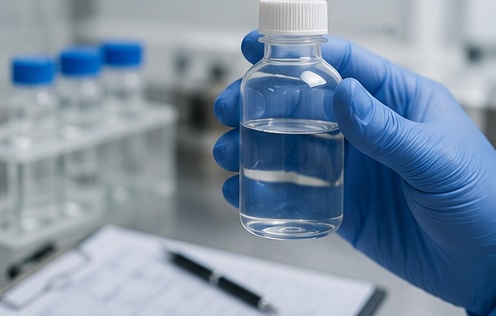
Microbiological sampling is unforgiving. Sample bottles must be appropriate to the parameter — sodium thiosulphate to neutralise chlorine, for example, when testing chlorinated supplies. Samples must reach a UKAS-accredited laboratory within the specified holding time, kept cool. And the chain of custody has to be documented end to end.
Get any of that wrong and the result tells you nothing useful — or, worse, it tells you something misleading. We frequently encounter historical sampling data where collection, storage or transport arrangements may affect confidence in the result.
How we approach water quality testing
Vectair Environmental works with a UKAS-accredited laboratory partner and our field engineers are trained in appropriate sample collection methods for a range of water quality parameters. We provide sampling regimes scoped to the actual risk profile of your building rather than a one-size-fits-all schedule.
To discuss a sampling regime for your site, call our team on 0118 981 7437 or email


